The Opera House
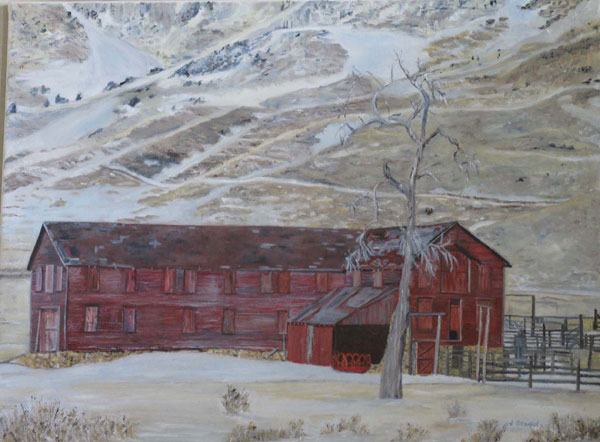
Oil on Canvas
24 ” x 28 ”
$950
Contact to Purchase
Mt. Angela
In 1882 Father Joseph Damiani of Rome, Italy became superior of St. Peter’s Mission. At that time only white and Indian boys were housed and educated there. Girls in the area received no schooling. So, recognizing the need, he arranged for the Ursulines to open a girls’ school and dormitory.
Mother Amadeus of the Heart of Jesus and four nuns were chosen to open the frontier school. They had already established the first Montana Ursuline convent in Miles City. When they were transferred to St. Peter’s accommodations were difficult. The nuns were given the old buildings constructured for the priests. The log houses had pole and clay roofs, floors of dirt, and bunks made of boards covered with straw for mattresses and buffalo hides as covers. Mother Amadeus contracted pneumonia shortly after her arrival, and her childhood nursemaid, Mary Fields, came from Ohio to care for her.
Mary, a tough, six foot, 250 pound black, began life in 1812 as a slave in Hickman County, Tennessee and was one of the few blacks taught to read and write. Mary found Montana to her liking and decided to stay. Once Mother Amadeus recovered, the nuns hired Mary as handyman at the school and to haul freight and supplies. She was a hard drinking, cigar smoking woman who was quite capable of using not only her fists but also her pistols and shot-gun. Legends have her killing several men, though only one can be documented. When she got into a shoot-out over salaries with a fellow employee, she was asked to leave. When she was about sixty, Mary delivered U.S. mail in the Cascade area and her route included St. Peter’s Mission. For nearly ten years, regardless of weather, road conditions, wolves, or thieves, Mary delivered the mail on time, sometimes having to walk many miles to do it. For this unbelievable feat she became known as “Stagecoach Mary”. When she was seventy, too worn to continue mail delivery, the nuns helped her open a laundry service in Cascade where she was so respected that the town once closed schools to celebrate her birthday. She died in 1914 and was buried in a cemetery located at the foot of the mountain trail that led to Saint Peter’s Mission.
Mother Amadeus became Superior General of the Ursulines of Montana, traveled widely to open new convents and was permanently injured in a train collision in Billings in 1902. This did not stop her from become head of the commission to organize schools for the Eskimo children in Alaska in 1910, a job she performed until her death in 1919. Like her friend, Mary Fields, she was buried in Montana.
As to the mission, the nuns lived and taught in the priests’ log buildings until 1891, when a magnificent three-story, stone convent, school, and chapel, named Mt. Angela, was completed across the road from St. Peter’s. The Ursulines then constructed a beautiful wooden building, dubbed the Opera House, since it had both the dormitory and auditorium. Mt. Angela was designated as the Motherhouse of the Ursulines of the West. Both white and Indian girls were accepted into the school until the government assumed educating the Indian children. When the Jesuits departed, the Ursulines taught both the boys’ and girls’ schools.
In 1908 the Jesuit boys’ school and dorm burned to the ground, thus ending the nuns’ ability to educate the males. In 1912 the school for girls, along with some of the nuns, were moved to Great Falls, and only the Indian students remained at St. Peter’s. In 1918, Mt. Angela and the girls’ school were totally destroyed by fire, and the Ursuline land was purchased by a rancher who sold most of the remaining building stones.
Where once the flourishing complex of grand buildings stood, now only the Opera House remains to give testimony to Mt. Angela’s wonderful history. Sadly, slowly decaying, it has been relegated to a barn.