St. Peter’s Mission Church
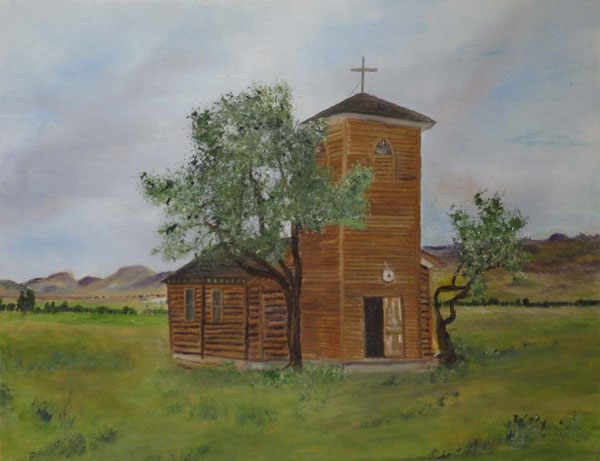
Oil on Canvas
24″ x 18 ”
$875
Contact to Purchase
Picturesquely located near Birdtail Rock, a scenic drive from Cascade, St. Peter’s is still a functioning Catholic Church for special events and holidays. Lovingly giving time, money, and expertise to complete the project, its loyal, small flock of parishioners is restoring the usually white-washed log church to its original grandeur.
The diocesan-owned church, out-buildings, and cemetery; along with the girls’ dorm, known as the opera house, on private land across the road, are all that remain of the prosperous teaching and mission complex. This community, run by Jesuits priests and brothers and Ursulines nuns, once numbered 149 people and was capable of providing for them with 300 head of cattle, grain fields, pastures, and gardens.
St. Peter’s was the fourth site chosen by the Jesuits in their attempt to settle among the Blackfoot Nation. In 1865 Father Imoda, Jesuit brothers, several workmen, and Indians erected the white-washed log church, and one of the priests carved the altar and tabernacle. The original position of the belfry, with its 800 pound bell, was at the corner of the church. They also built a few other buildings used as living quarters. In 1866, when the tribe drove other Jesuits out of their first three Montana missions, all fled to St. Peter’s. However, the Indians followed their trails, and the following day they were again forced to flee. They left the site in the care of a nearby rancher, Thomas Moran.
Eight years later the Jesuits, determined to teach the Blackfoot children, returned but within a few weeks Congress ordered the tribe moved sixty miles away and put into the hands of Protestant missionaries. The mission then became a school for both ranch and Indian boys, and wooden classrooms were built near the chapel.
One of the teachers was Louis Royale, who was part Matisse Indian and part-white. He was a Saskatchewan revolutionary whom the priests did not like. Eventually he returned to Canada to lead an insurrection against the government, was caught, and hanged.
A Jesuit Seminary was built and in 1892 a fine stone school constructed for boys and Ursuline nuns arrived to start a girls’ school. In 1895, when the mission was flourishing, the government once again changed policies, decided to open government schools, and ended all subsidies for Native Americans. This forced the Jesuits to move to their four remaining missions in Montana, leaving the nuns to operate both schools until fire completely destroyed the boys’ structure in 1908.
What remains of the Jesuit compound is the beautiful, little church, a few wooden buildings decaying in the winds of time, parts of the stone walls from the magnificent boys’ edifice littering the sagebrush, and the little hilltop cemetery overlooking the mission.